// CASE STUDY : COMPETITION PREP : WEB APP : 2026
Wynit
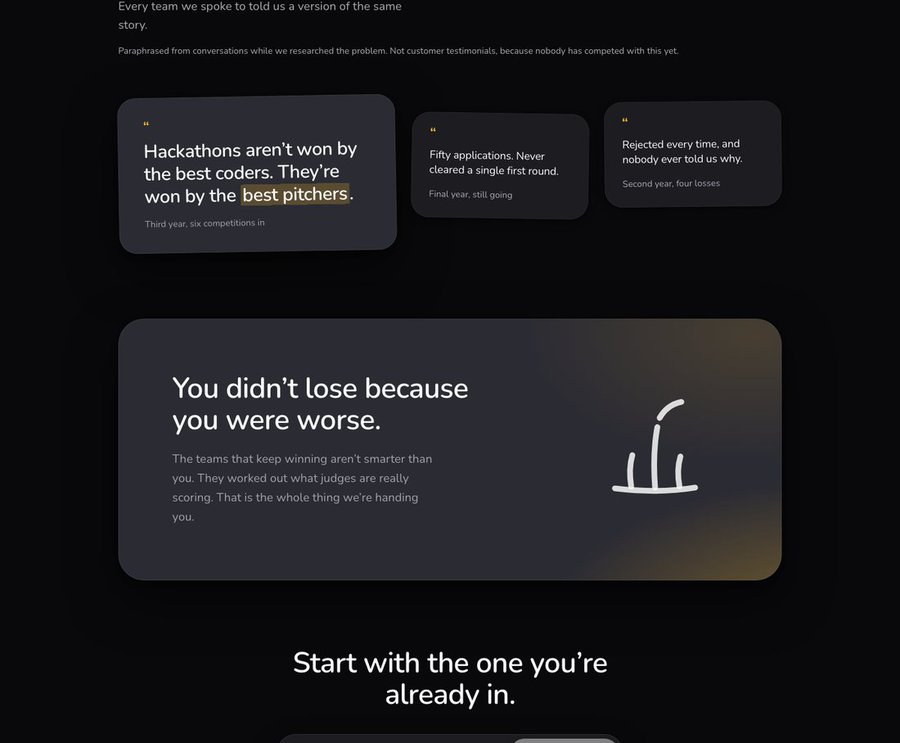
Competition prep is scattered across WhatsApp groups and word of mouth, so the people who win are usually the ones who already knew a winner.
Open the live demoThe problem
Everyone can enter. Almost nobody knows how they will be judged.
Preparation for hackathons and case competitions has no centralised path. It lives in WhatsApp groups, half-finished Notion dumps, and seniors who happen to remember what worked last year. If you are not already connected to someone who has won, you start from nothing every single time.
The brief is the sharpest version of this. Every competition publishes exactly how it will score you, and almost nobody reads it. Students spend weeks building the wrong thing well, then lose to a team that read two paragraphs and built to the rubric.
My thinking
Five weeks in, the funnel disagreed with us. We had assumed acquisition was the constraint. It was not.
The solution
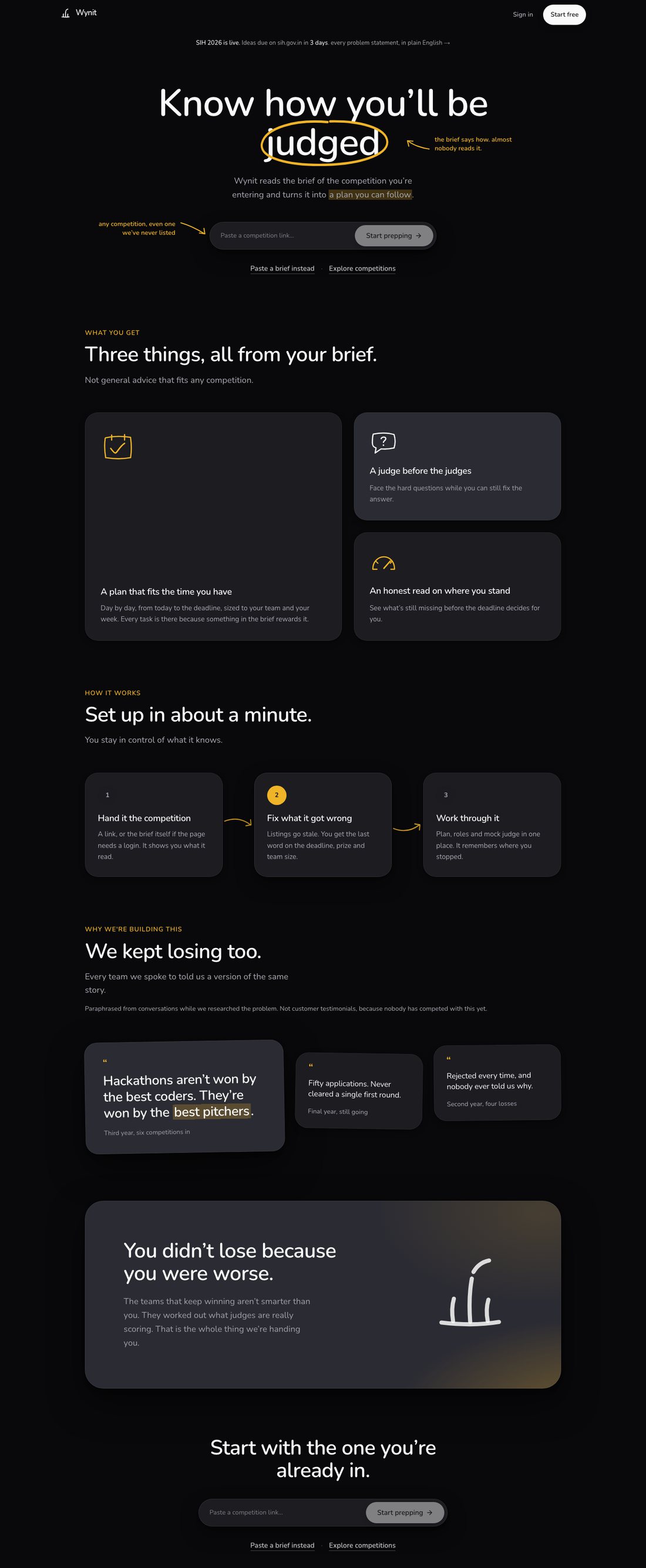
A product that reads the brief of the competition you are entering and turns it into a plan you can follow.
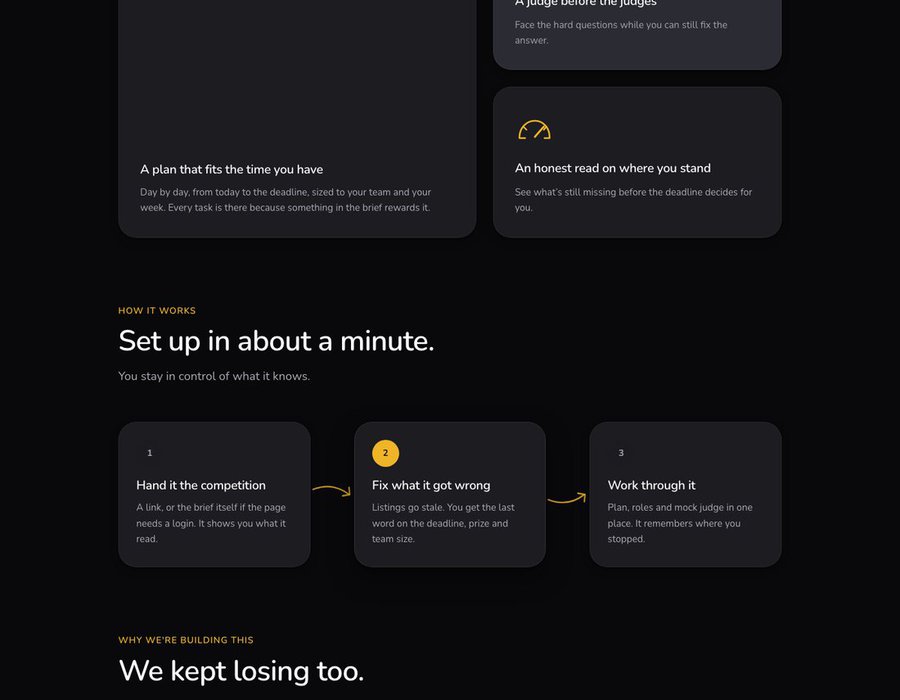
Paste a competition link - even one we have never listed - and Wynit pulls the brief apart: what is being scored, what is expected, and what to do about it in the time you have. Not general advice that fits any competition.
Discovery ran across several universities, combining forms with direct outreach to students and campus leads. The qualitative work told us what people were trying to do; PostHog told us where they stopped being able to do it. Neither was sufficient alone.
DECISION 01
Rebuild the prep flow, not patch it
The drop-off was structural, so a nudge would only have moved where people left.
The rebuilt flow holds 72% sign-in to onboarding and 68% retention through SIH prep to browse.
DECISION 02
Instrument before scaling
Without a funnel we were guessing which half of the product was working.
PostHog made the mid-flow leak visible, which is the only reason we rebuilt the right thing.
DECISION 03
Gate the AI voice model, not the core
Prep has to be free to be useful at all; the paid thing should be what you want only once you are serious.
Freemium split scoped around a multi-tonal AI voice model for live pitch grilling as the first paid feature.
Execution
Concept to Product Hunt in roughly five weeks, in sprints, with five people covering everything.
The five of us split product, engineering, sales and unit economics between us with no fixed titles. I owned the technical layer and the analytics, which made the loop between shipping a change and seeing it in the funnel one person long.
Launch was deliberately early. A beta in front of real students produces drop-off data that no amount of internal debate will, and Product Hunt was the fastest way to get a cohort through the door at once.
- STACK
- MongoDB : Express : React : Node
- ANALYTICS
- PostHog
- DISCOVERY
- Forms + direct outreach, multi-campus
- CADENCE
- Sprints, ~5 weeks to launch
- LAUNCH
- Product Hunt, Top 50 of launch week
- MONETISATION
- Freemium, scoped not shipped
Impact
A FLOW THAT LOST PEOPLE MID-WAY NOW CARRIES 72% OF THEM THROUGH ONBOARDING
~500
live users
72%
sign-in to onboarding
68%
retention, SIH prep funnel
Top 50
Product Hunt launch week
Onboarding conversion at 72%
Measured sign-in to onboarding in PostHog, by rebuilding the prep flow around fresh qualitative research rather than patching the drop-off point.
68% retention through the SIH funnel
Measured from SIH prep through to browse, by making the next step obvious at the exact point where users had previously stopped.
~500 live users, Top 50 on launch week
Measured on Product Hunt and in-product, by launching a beta early enough that real usage - not opinion - set the roadmap.
What I learned
The funnel is allowed to disagree with you, and it is cheaper to believe it early. We spent weeks treating acquisition as the problem while the data said the product was losing people who had already chosen to be there. Every week of that argument was a week the leak stayed open.
Shipping the instrumentation before the growth push is what made every later decision possible. Without PostHog we would have rebuilt something, probably the wrong thing, and never known whether it worked.